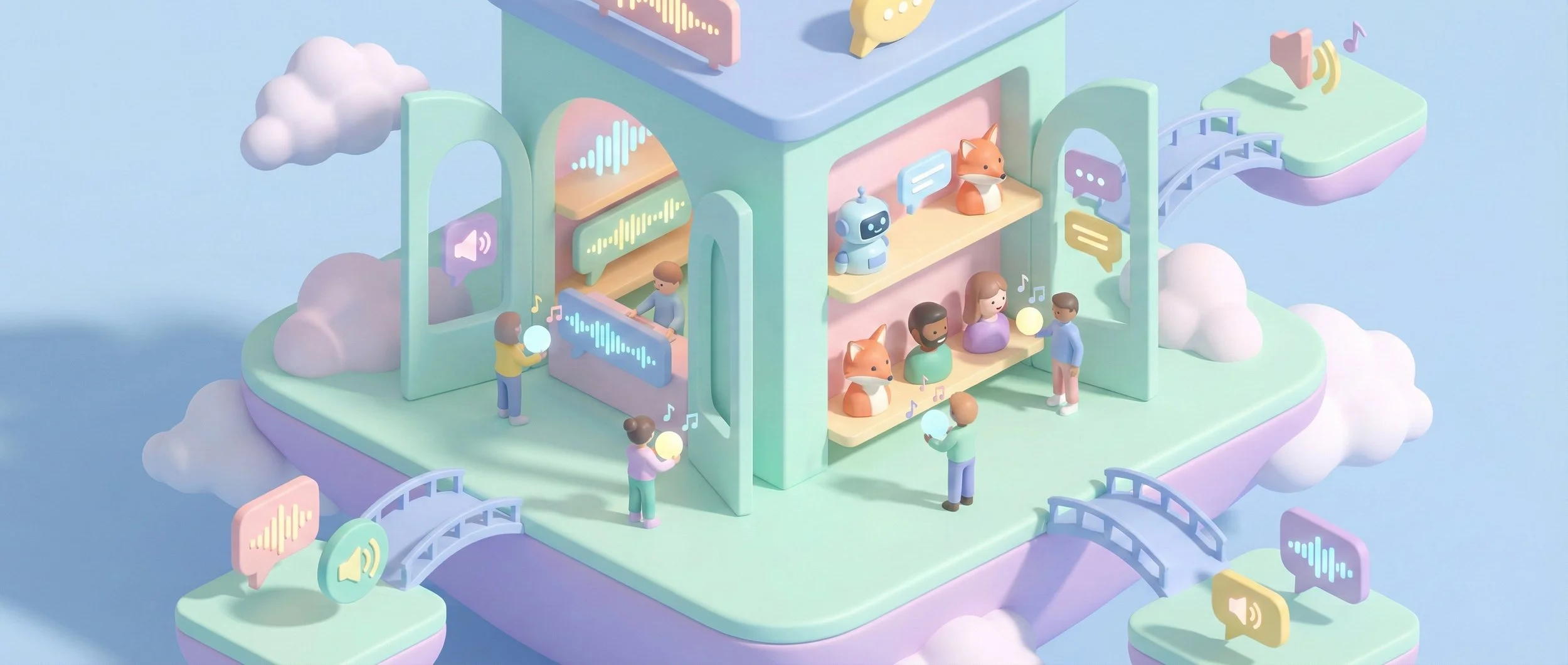
MyShell: The "App Store" for Open-Source Voice Strategy
In the rapidly solidifying landscape of AI voice technology, where closed-garden giants like ElevenLabs and OpenAI dominate with proprietary models, MyShell has carved out a radical niche: it is building the decentralized "app store" for the voice economy.
The Engine: OpenVoice
Founded in 2023 and aggressively expanding through 2024 and 2025, MyShell distinguishes itself not just as a tool, but as an ecosystem. Its strategy relies on two pillars: the democratization of high-end voice technology through open-source models, and the creation of a "creator economy" where users can monetize distinct voice personalities.
At the heart of MyShell’s strategy is OpenVoice, an instant voice cloning technology developed in collaboration with researchers from MIT and Tsinghua University. Unlike competitors that require minutes of audio to clone a voice effectively, OpenVoice requires only a short audio clip to replicate a speaker’s tone color with startling accuracy.
Crucially, OpenVoice offers granular control over voice styles—allowing users to manipulate emotion, rhythm, intonation, and pauses independently of the speaker's original tone. It also supports zero-shot cross-lingual cloning, meaning a cloned voice can speak fluently in languages the original speaker never learned, without requiring massive multi-lingual training datasets. By open-sourcing this model (under MIT license for commercial use), MyShell effectively commoditized what was once a premium, gated capability, allowing developers everywhere to build voice apps without paying exorbitant API fees to big tech firms
The "App Store" for Personalities
MyShell’s business model is arguably more innovative than its code. It operates as a decentralized platform where creators build "AI subjects"—bots with specific personalities, voices, and knowledge bases.
Imagine a history teacher building a "Winston Churchill" bot that answers student questions in Churchill’s exact voice and rhetorical style. In the MyShell ecosystem, that teacher becomes a developer. If the bot becomes popular, the creator earns Shell Coins (the platform's native token), effectively monetizing their prompt engineering and voice curation skills. This "create-to-earn" model incentivizes a flood of high-quality, diverse content, moving the industry away from generic "corporate" assistants (like Siri) toward millions of specialized, human-like agents.
Strategic Impact for 2025
For business strategists, MyShell represents a shift from owning a voice to renting a personality.
De-risking AI Adoption: Because the underlying models are open-source, enterprises can host them privately, avoiding data privacy issues associated with sending sensitive voice data to third-party clouds.
Campaign Specificity: Brands no longer need one "forever voice." A marketing team can rent a "gritty, high-energy" voice bot for a sports campaign and a "soothing, empathetic" bot for a wellness app from the MyShell marketplace, drastically reducing production costs.
By combining the viral mechanics of a creator economy with the technical rigor of open-source research, MyShell is betting that the future of voice isn't a single, all-knowing supercomputer—it's a noisy, vibrant marketplace of millions of unique digital souls.