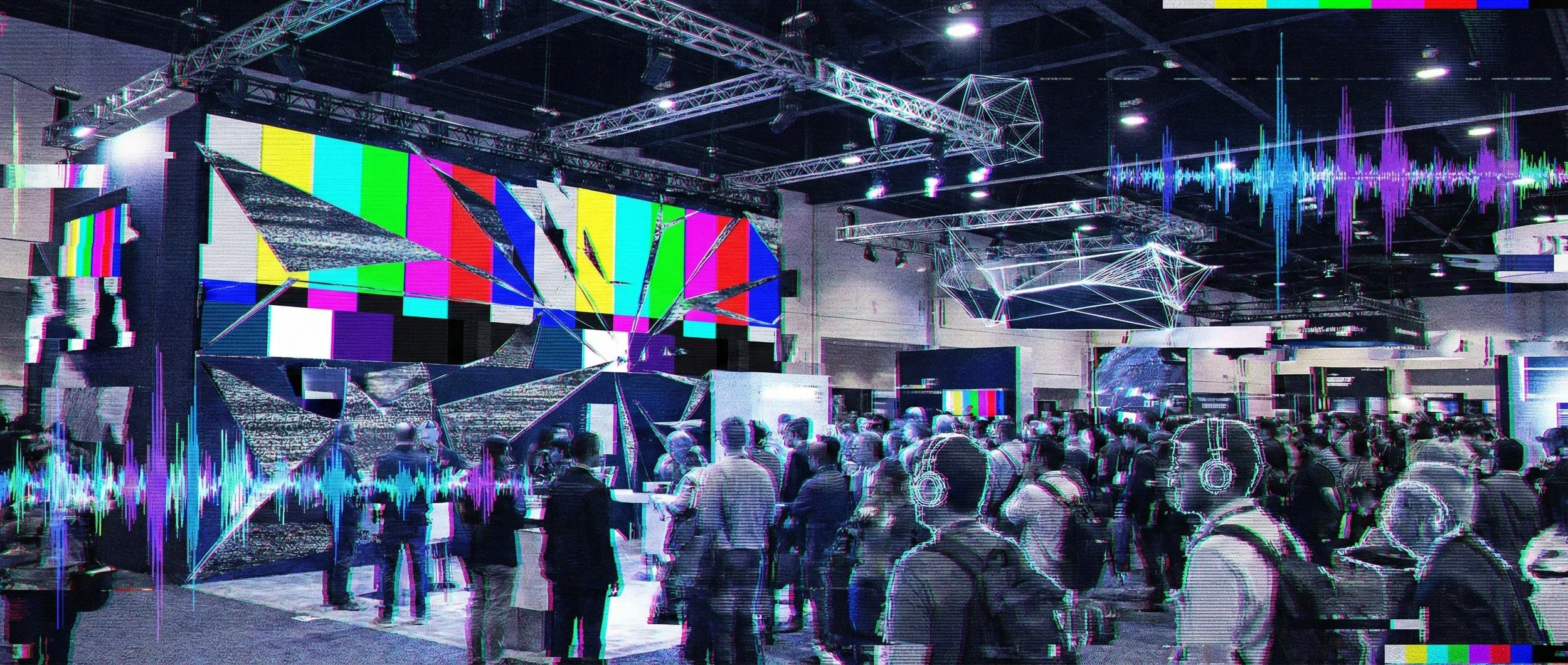
The "Silent" Trade Show Floor: How Silence Became the Loudest Strategy
For decades, the metric of success at a trade show was decibels. The louder your booth, the bigger your screen, and the more thumping your bass, the more attention you theoretically commanded. But by late 2025, a counter-intuitive trend had taken over the expo halls of CES, InfoComm, and MWC: the "Silent" Trade Show Floor.
Future Sounds Blog Podcast
The Mechanics of Silence
The "Silent" Trade Show Floor relies on two distinct technologies: "Silent Conference" headphone systems and advanced acoustic beamforming.
The most visible change is the proliferation of "Silent Theaters" within open booths. Companies like Implecho and Silent Conference have normalized the use of multi-channel wireless headphones. Walk past a major booth at MWC 2025, and you wouldn't hear a keynote speaker shouting over a PA system. Instead, you’d see 50 people sitting in rapt attention, wearing glowing LED headphones. This technology allows a single booth to host three simultaneous sessions—a technical deep-dive on Channel 1, a sales pitch on Channel 2, and a Mandarin translation on Channel 3—all within a 20x20 foot space, without a single sound bleeding out to the aisle.
Beamforming: The Invisible Headphone
While headphones are the standard, the premium end of the market—led by innovators like Holoplot and Fraunhofer IDMT—is pushing "directed audio." Using massive arrays of small speakers, these systems can steer sound waves like a laser beam.
At InfoComm 2025, this created "audio spotlights." An attendee could step onto a specific floor marker and instantly hear a crisp, high-fidelity demo. Step one foot to the left, and the sound vanished, replaced by the ambient hum of the room. This allowed exhibitors to create "sonic corridors" where different products "spoke" to visitors only when they paid attention, eliminating the chaotic wall of noise that typically plagues electronics shows.
The Strategy: Attention Economics
The move to silence is driven by hard data. Marketing analytics from 2024–2025 revealed that "dwell time" (how long a visitor stays in a booth) increased by upwards of 40% in silent environments.
When an attendee puts on headphones, two psychological shifts happen:
The "Opt-In" Commitment: putting on a headset is a micro-conversion. The visitor has physically committed to listening, which drastically reduces the likelihood of them walking away mid-pitch.
Isolation: The headphones physically block out competitors. For those few minutes, the visitor is no longer in a chaotic hall; they are in a private 1-on-1 session with the brand.
The Future of the Floor
By 2026, "noise pollution" clauses have begun appearing in exhibitor contracts, fining brands that exceed certain decibel levels. The trade show of the future is quieter, more intimate, and paradoxically, more communicative. In a world screaming for attention, brands found that the best way to be heard was to whisper.